Every Story Matters: Breast Cancer Awareness Month 2026
share article




Behind every breast cancer statistic is a person with a name, a family and a story of their own. This October, as the world marks Breast Cancer Awareness Month, we want to look past the numbers and focus on the people: the patients, the survivors, the families who stand beside them, and the healthcare professionals who are often the first to notice that something has changed.
Every Story is Unique, Every Journey Matters
The 2026 campaign theme, Every Story is Unique, Every Journey Matters, is a reminder that breast cancer never looks the same twice (Awareness Days). Two people with the same diagnosis can face very different symptoms, treatments, emotions and outcomes.
For some, the journey starts with a lump found during a self-exam. For others, it begins with a routine mammogram or an ultrasound ordered because of dense breast tissue. Some are young mothers, some are grandparents, and a small number are men. Each of these paths deserves to be seen, understood and supported.
This idea matters in clinical care too. Recognising that every patient is different starts with healthcare professionals who have learned to notice the subtle differences in how breast tissue looks and feels.
Why early detection still changes the story
Breast cancer is the most common cancer in women worldwide. In 2022, around 2.3 million new cases were diagnosed and 670,000 deaths were recorded globally, and the International Agency for Research on Cancer projects that annual cases could reach 3.2 million by 2050 if current trends continue (IARC). Roughly half of all breast cancers occur in women with no specific risk factors beyond sex and age (WHO).
That last point is why awareness matters for everyone, not only those with a family history. Where a cancer is found has a huge influence on how the story unfolds. In high-income countries, where screening and treatment are widely available, 83% of women diagnosed survive, while in low-income countries more than half of women diagnosed die from the disease (APP).
Early detection relies on a few simple habits:
• Know what is normal for you. Changes such as a new lump, skin dimpling, a change in nipple shape or unusual discharge should be checked by a doctor.
• Follow screening recommendations. Mammography remains the standard screening tool, with ultrasound and MRI often used for dense breast tissue or higher-risk patients.
• Talk about it. Many people delay a check-up out of fear or uncertainty. A conversation with a friend, partner or clinician can be the first step.
Preparing clinicians for every kind of patient
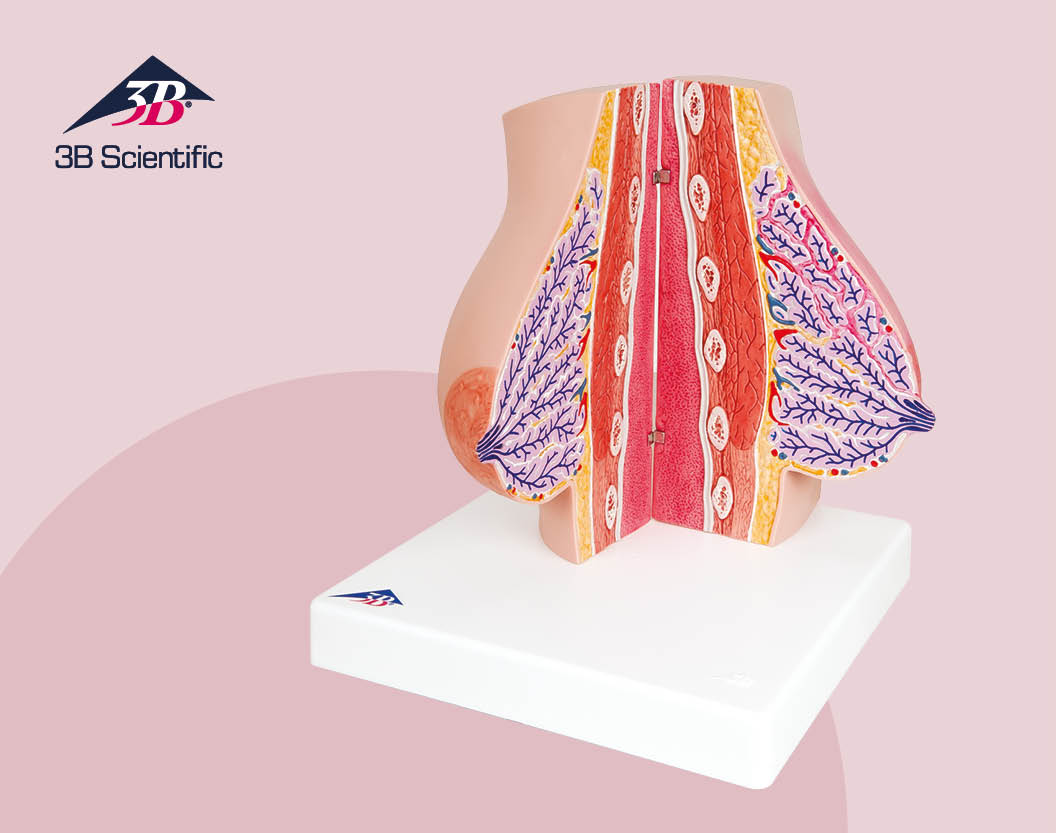
If every patient's story is unique, then clinicians need to be ready for a wide range of findings. Reading about a suspicious lump is not the same as feeling one, and confidence in a breast exam comes from repeated, hands-on practice. 3B Scientific's breast models give learners that practice in a safe, realistic setting.
• Female breast with healthy & unhealthy tissue lets trainees compare normal tissue with pathological changes side by side, building the tactile memory needed to spot the difference.
• Single breast model with benign tumor helps learners understand that not every lump is cancer, and practise describing size, shape and mobility accurately.
• Breast self-examination model is a clear, approachable tool for teaching patients and the public how to check themselves correctly.
• Wearable breast self-examination model can be worn by a standardised patient or educator, making self-exam teaching more personal and closer to a real consultation.
• SONOtrain breast model with tumours supports ultrasound training, helping clinicians locate and assess lesions with greater diagnostic accuracy.
Together, these models help nurses, midwives, medical students and physicians examine with confidence, explain findings with empathy and teach patients to become active partners in their own breast health.
Better-trained hands mean more cancers caught early, and more stories with hopeful chapters.
How to honour every journey this October
• Listen. Ask someone affected by breast cancer how they are really doing, and let them tell their story in their own way.
• Book your own check. Schedule a screening or remind someone you care about to do the same.
• Share reliable information. Post facts about symptoms and screening from trusted health organisations rather than myths.
• Support research and care. Donate to, volunteer with or fundraise for a breast cancer charity in your community.
• Invest in training. If you work in healthcare education, make breast examination and ultrasound practice a regular part of your curriculum.
Writing the next chapter together
No two breast cancer journeys are the same, but every one of them is shaped by the people involved: the person who notices a change, the clinician who knows what to look for, and the community that offers support along the way. This Breast Cancer Awareness Month, let's listen more closely, detect earlier and train better, so that more stories are told by survivors.
At 3B Scientific, we are proud to support the educators and healthcare professionals who make that possible, every October and all year round.
Every Story is Unique, Every Journey Matters
The 2026 campaign theme, Every Story is Unique, Every Journey Matters, is a reminder that breast cancer never looks the same twice (Awareness Days). Two people with the same diagnosis can face very different symptoms, treatments, emotions and outcomes.
For some, the journey starts with a lump found during a self-exam. For others, it begins with a routine mammogram or an ultrasound ordered because of dense breast tissue. Some are young mothers, some are grandparents, and a small number are men. Each of these paths deserves to be seen, understood and supported.
This idea matters in clinical care too. Recognising that every patient is different starts with healthcare professionals who have learned to notice the subtle differences in how breast tissue looks and feels.
Why early detection still changes the story
Breast cancer is the most common cancer in women worldwide. In 2022, around 2.3 million new cases were diagnosed and 670,000 deaths were recorded globally, and the International Agency for Research on Cancer projects that annual cases could reach 3.2 million by 2050 if current trends continue (IARC). Roughly half of all breast cancers occur in women with no specific risk factors beyond sex and age (WHO).
That last point is why awareness matters for everyone, not only those with a family history. Where a cancer is found has a huge influence on how the story unfolds. In high-income countries, where screening and treatment are widely available, 83% of women diagnosed survive, while in low-income countries more than half of women diagnosed die from the disease (APP).
Early detection relies on a few simple habits:
• Know what is normal for you. Changes such as a new lump, skin dimpling, a change in nipple shape or unusual discharge should be checked by a doctor.
• Follow screening recommendations. Mammography remains the standard screening tool, with ultrasound and MRI often used for dense breast tissue or higher-risk patients.
• Talk about it. Many people delay a check-up out of fear or uncertainty. A conversation with a friend, partner or clinician can be the first step.
Preparing clinicians for every kind of patient
If every patient's story is unique, then clinicians need to be ready for a wide range of findings. Reading about a suspicious lump is not the same as feeling one, and confidence in a breast exam comes from repeated, hands-on practice. 3B Scientific's breast models give learners that practice in a safe, realistic setting.
• Female breast with healthy & unhealthy tissue lets trainees compare normal tissue with pathological changes side by side, building the tactile memory needed to spot the difference.
• Single breast model with benign tumor helps learners understand that not every lump is cancer, and practise describing size, shape and mobility accurately.
• Breast self-examination model is a clear, approachable tool for teaching patients and the public how to check themselves correctly.
• Wearable breast self-examination model can be worn by a standardised patient or educator, making self-exam teaching more personal and closer to a real consultation.
• SONOtrain breast model with tumours supports ultrasound training, helping clinicians locate and assess lesions with greater diagnostic accuracy.
Together, these models help nurses, midwives, medical students and physicians examine with confidence, explain findings with empathy and teach patients to become active partners in their own breast health.
Better-trained hands mean more cancers caught early, and more stories with hopeful chapters.
How to honour every journey this October
• Listen. Ask someone affected by breast cancer how they are really doing, and let them tell their story in their own way.
• Book your own check. Schedule a screening or remind someone you care about to do the same.
• Share reliable information. Post facts about symptoms and screening from trusted health organisations rather than myths.
• Support research and care. Donate to, volunteer with or fundraise for a breast cancer charity in your community.
• Invest in training. If you work in healthcare education, make breast examination and ultrasound practice a regular part of your curriculum.
Writing the next chapter together
No two breast cancer journeys are the same, but every one of them is shaped by the people involved: the person who notices a change, the clinician who knows what to look for, and the community that offers support along the way. This Breast Cancer Awareness Month, let's listen more closely, detect earlier and train better, so that more stories are told by survivors.
At 3B Scientific, we are proud to support the educators and healthcare professionals who make that possible, every October and all year round.
Altri articoli

29. September 2026
Don't Miss a Beat: World Heart Day 2026
25. September 2026
A Lifetime of Lung Health: World Lung Day 2026