e Sono EMS Advanced Course - Multiuser License


e Sono EMS Advanced Course - Multiuser License
e Sono EMS POCUS Advanced
Advanced simulation-based ultrasound training for paramedics and prehospital teams ready to apply POCUS in complex, high-acuity scenarios. From shock differentiation to full eFAST — no hardware required.
Why e Sono
Built for high-acuity prehospital decision-making
High-acuity clinical scenarios
Scenarios cover shock differentiation, complex trauma, ARDS, pulmonary embolism, and resuscitation — reflecting the full complexity of critical prehospital care.
Real patient scans
All 60 exercises use actual clinical ultrasound data, giving learners authentic exposure to advanced pathology before encountering it in the field.
Immediate feedback
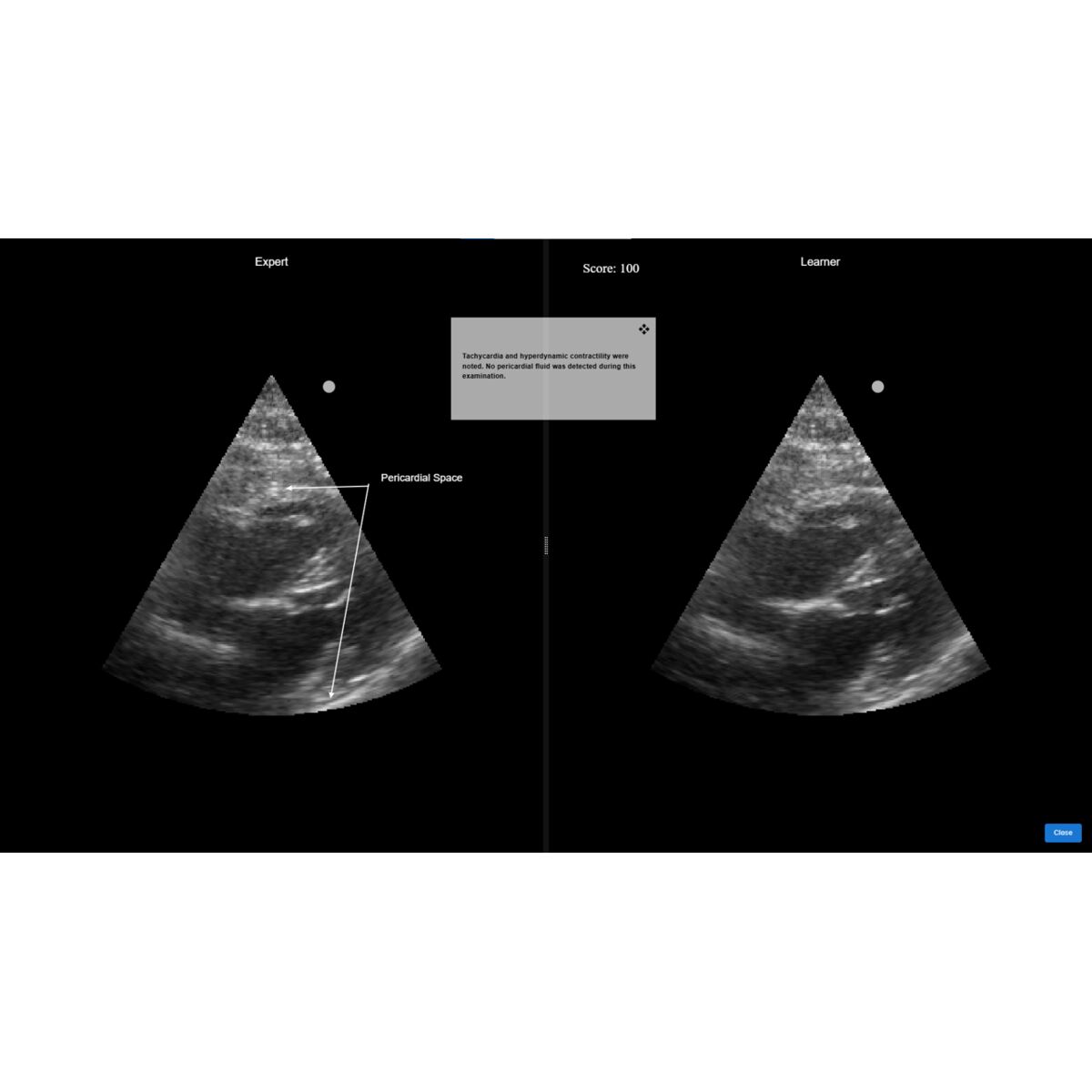
Automated evaluation and expert reference views after each exercise support independent progress without an instructor present.
No hardware needed
Train anywhere on desktop, laptop, or tablet. An optional smartphone probe controller is available for iOS and Android.
Scalable for organizations
Multi-user licenses support ALS programs, critical care transport teams, EMS educators, and simulation centers training multiple providers at once.
Guided with demos
Live demonstration videos accompany every advanced view, covering step-by-step probe positioning, image acquisition, and view optimization.
Audience
Who this course is for
Learning outcomes
What you will learn
Course overview
Two-module structure
- Advanced cardiac views: PLAX, PSAX, A4C step-by-step acquisition
- IVC evaluation in challenging patients
- LV systolic function and pathologies
- Advanced lung ultrasound: curtain sign, consolidation, pleural effusion
- eFAST protocol: normal and pathological findings
- Normal anatomy and advanced pathological reference findings
- Cardiogenic pulmonary edema with pleural effusion and LV dysfunction
- Septic shock: severe pneumonia and hyperdynamic LV
- Smoke inhalation: acute lung injury patterns
- Trauma eFAST: three complex MVA cases
- Pulmonary embolism: RV strain and femoral DVT
- Pseudo-PEA: severe hypovolemia
Course content
Full scan inventory
Advanced POCUS training
| Lesson | Subject |
|---|---|
| Cardiac ultrasound | PLAX: Step-by-step image acquisition |
| PSAX: Step-by-step image acquisition | |
| A4C: Step-by-step image acquisition | |
| IVC evaluation in challenging patients | |
| Left ventricular systolic function — pathologies | |
| Lung US — advanced | Curtain sign |
| Lung consolidation (pneumonia) | |
| Pleural effusion & lung atelectasis | |
| eFAST examination | eFAST protocol (normal) |
| eFAST pathologies |
Clinical scenarios
| Presentation | Findings |
|---|---|
| Chest pain | Normal cardiac US exam |
| ESRD patient w/ dyspnea and chest pain | LV dysfunction (mild) |
| Edema and worsening dyspnea | Cardiogenic pulmonary edema: confluent B-lines; bilateral pleural effusion; atelectasis; LV dysfunction |
| Respiratory distress and altered mental status | Septic shock: severe pneumonia; hyperdynamic LV function |
| Smoke inhalation | Acute lung injury: B-lines; pleural effusion; atelectasis |
| Motor vehicle accident (eFAST) | Positive Morison’s pouch (moderate); positive perisplenic (small) |
| Motor vehicle accident (eFAST) | Positive perisplenic (small); positive pelvis (moderate) |
| Motor vehicle accident (eFAST) | Pneumothorax; positive Morison’s pouch (small); pericardial effusion (small) |
| Dyspnea, hemoptysis, chest pain | Mild RV strain; femoral vein DVT |
| Sudden collapse | Pseudo-PEA (severe hypovolemia) |
Platform features
What's included
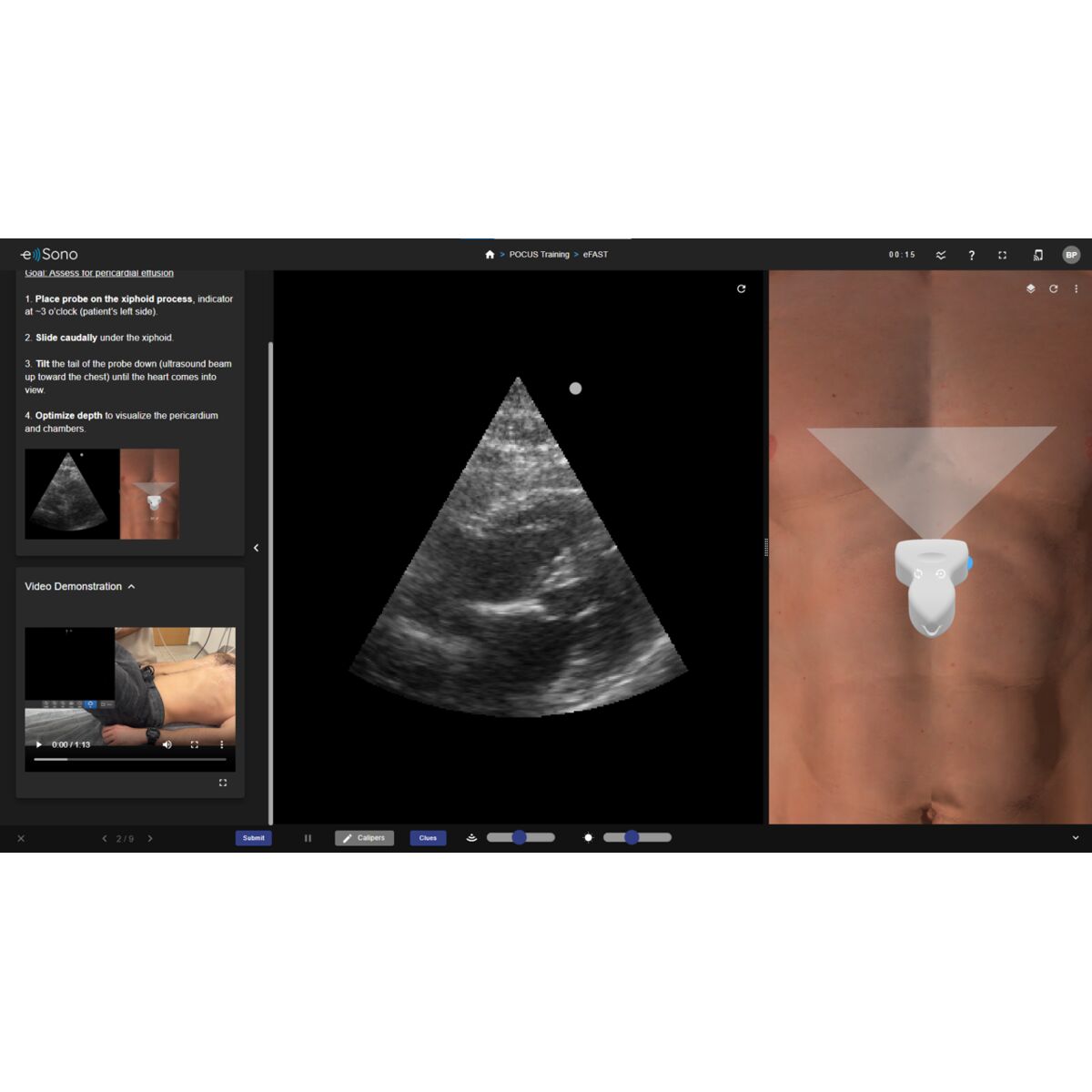
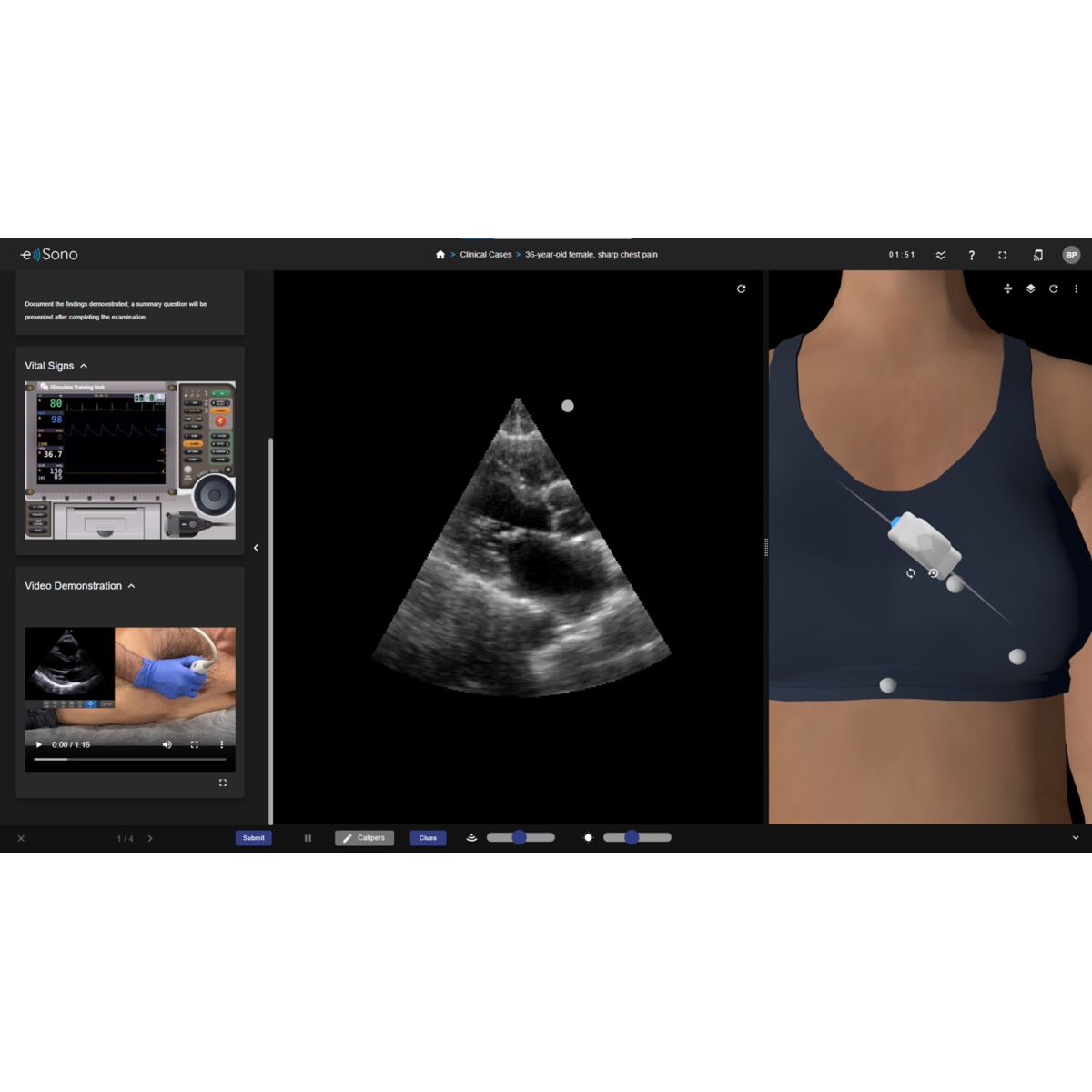
Every advanced ultrasound view is accompanied by a real patient demonstration video covering probe position and scanning technique.
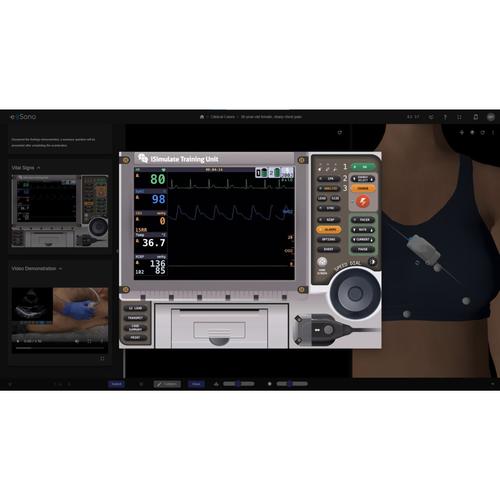
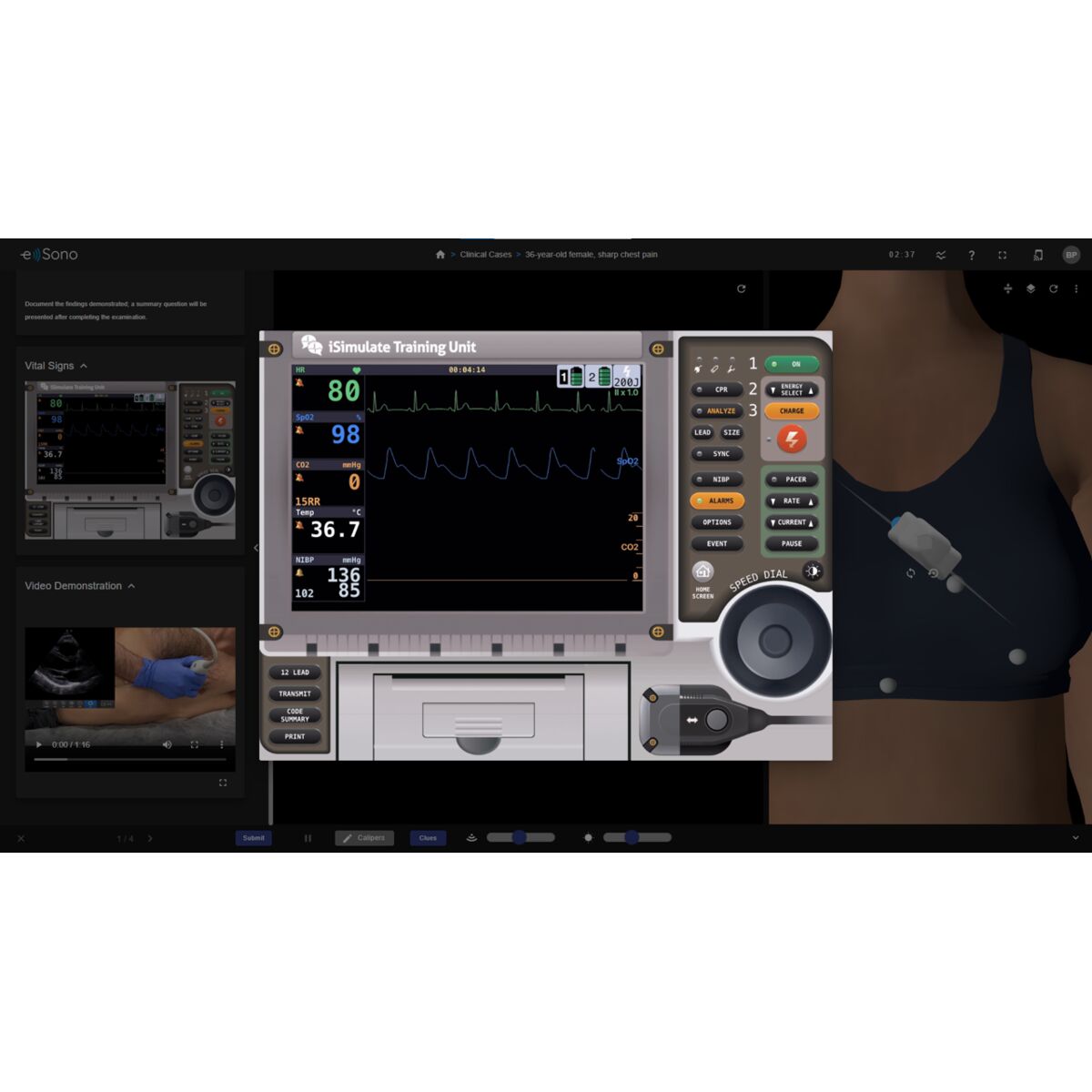
Integrated patient monitor with ECG, SpO², blood pressure, and capnography reflects authentic emergency care workflows in each scenario.
Realistic virtual patient models across all high-acuity EMS simulation scenarios.
Depth, gain, annotations, measurements — mirroring real machine workflows.
Immediate feedback with expert reference views after every exercise.
Embedded clinical reasoning questions reinforce interpretation and decision-making alongside image acquisition tasks.
On-screen orientation aids help learners understand probe-to-anatomy relationships for complex views.
e Sono Phone Probe turns a smartphone into a probe controller (iOS and Android).
Licensing & delivery
Choose your license
Organization license
Recommended for ALS programs, critical care transport teams, EMS schools, simulation centers, and distributor-led customer projects where multiple learners need access.
Individual license
Recommended for individual learners and self-study. Same full course content and simulation quality as the organization license.
All access is cloud-based — no ultrasound machine or additional hardware required. No installation needed.
Technical requirements
Minimum system requirements
Device
Desktop, laptop, or tablet
Operating system
Windows 10 (64-bit), macOS 11+, iPadOS 14+
Processor
Intel Core i5 (8th Gen), AMD Ryzen 5 3000, Apple M1, or A12 Bionic
Memory
8 GB RAM
Storage
256 GB SSD or HDD with 10 GB free
Internet
30 Mbps download / 5 Mbps upload
Browser
Chrome, Firefox, Safari, Edge, or Opera
Input
Keyboard and mouse, or touchscreen
Graphics
Intel UHD 620 or equivalent integrated GPU
Optional add-on
Train with your phone as a probe controller
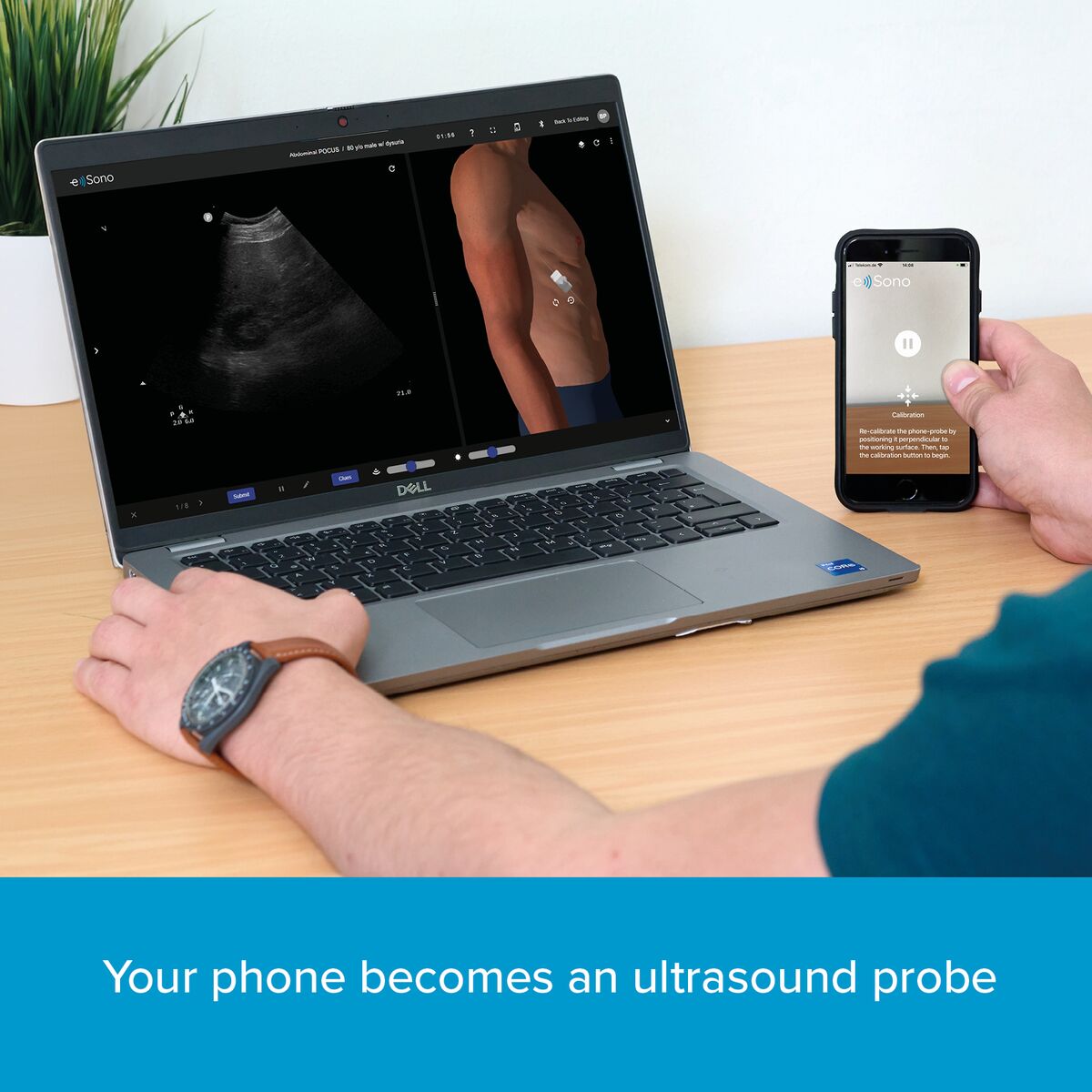 |
The e Sono Phone Probe app turns your smartphone into a physical probe controller. Holding and tilting your phone the way you would hold a real probe builds hand-eye coordination and a better feel for probe positioning — without needing a manikin or lab time. Free to download. An active e Sono license is required. |
See it in action
Product overview video
| Brand | e Sono |
Documentation

- Secure online payment with SSL
- Expert advice
- Easy returns & exchanges
- International shipping available